

ANNOUNCEMENT
Heat Stress in Poultry: Understanding the Physiological Challenge and the Role of Nutritional Support

Heat Stress Is More Than High Temperature
Heat stress is one of the most significant challenges facing modern poultry production, particularly in regions characterized by prolonged periods of high ambient temperatures and humidity. Its consequences extend far beyond temporary discomfort, affecting flock health, productivity, welfare, and ultimately the economic sustainability of poultry operations.
Commercial losses associated with heat stress include reduced feed intake, impaired feed conversion ratio (FCR), slower growth, lower egg production, poor eggshell quality, reduced fertility, increased disease susceptibility, and higher mortality. However, these visible production losses are merely the outcome of complex physiological disturbances occurring within the bird.
Understanding these mechanisms is essential for developing effective nutritional and management strategies that protect flock performance during periods of thermal stress.
The Physiology of Heat Stress in Poultry
Unlike mammals, poultry do not possess sweat glands. Their primary mechanism for dissipating excess body heat is evaporative cooling through panting.
While panting is an effective survival mechanism, prolonged hyperventilation results in excessive loss of carbon dioxide (CO₂), leading to respiratory alkalosis—a condition characterized by elevated blood pH. This alteration in acid-base balance initiates a cascade of physiological responses that affect multiple organ systems.
As blood pH increases, the kidneys compensate by excreting greater amounts of sodium, potassium, bicarbonate, and other electrolytes. At the same time, the availability of ionized calcium decreases, negatively influencing eggshell formation, muscle function, and skeletal metabolism.
Simultaneously, blood flow is redirected away from the gastrointestinal tract toward peripheral tissues to facilitate heat dissipation. Reduced intestinal perfusion compromises enterocyte integrity, increasing intestinal permeability and reducing nutrient absorption. Oxidative stress and elevated corticosterone concentrations further suppress immune competence, making birds more susceptible to secondary infections and production losses.
Why Water-Based Nutritional Support Matters
One of the defining characteristics of heat stress is the inverse relationship between feed and water intake.
As environmental temperatures rise, birds consume significantly less feed while substantially increasing water consumption. Consequently, drinking water becomes the most efficient route for delivering nutritional support precisely when birds need it most.
A comprehensive heat stress support strategy should therefore aim to:
- Maintain cellular hydration
- Restore electrolyte balance
- Protect intestinal integrity
- Reduce oxidative stress
- Encourage voluntary water consumption
Scientific Principles Behind BETAMAJ®
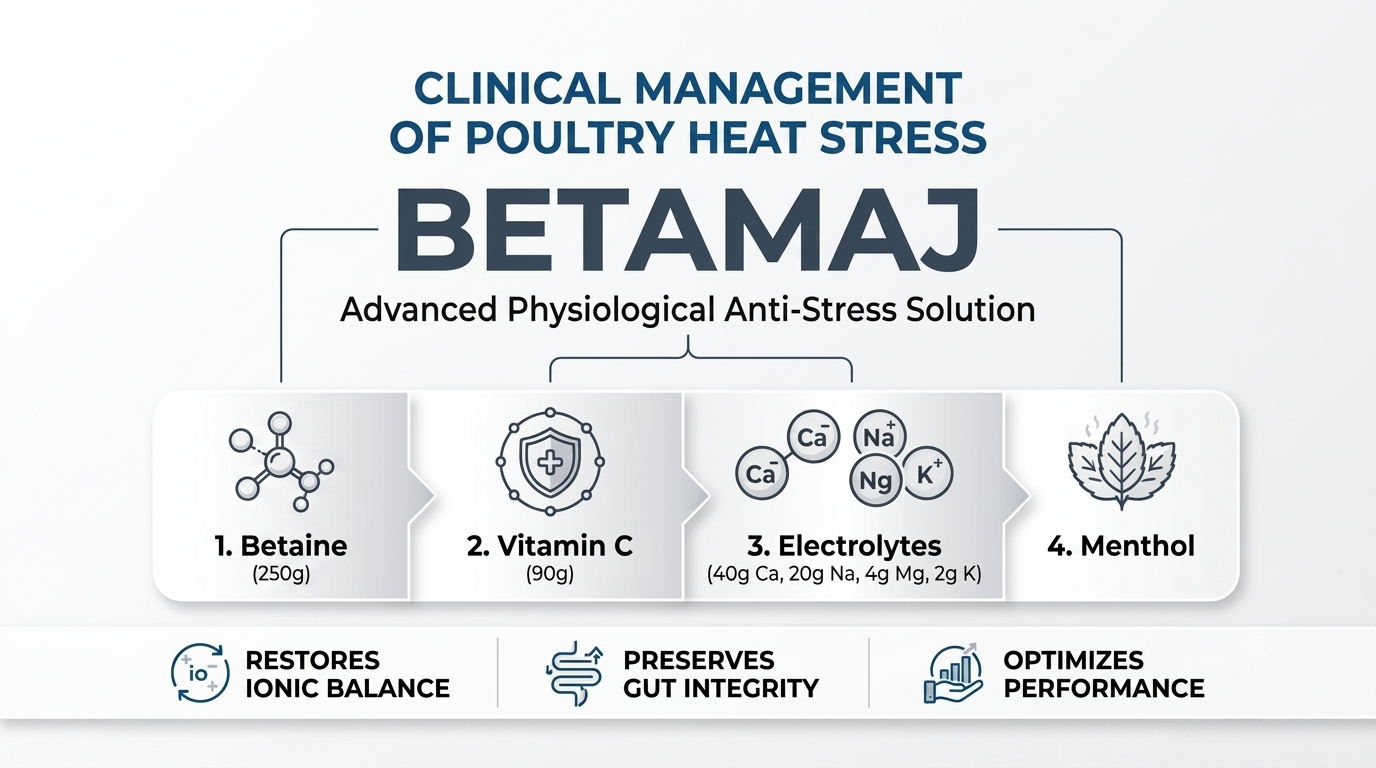
BETAMAJ® has been developed by Endimaj for Specialized Chemical & Pharmaceutical Industries as a water-soluble nutritional support solution designed to help poultry cope with periods of thermal challenge.
Its formulation combines complementary functional ingredients that target several physiological pathways affected during heat stress.
Betaine – Cellular Osmoprotection
Betaine acts as a natural organic osmolyte, helping cells maintain intracellular water balance without increasing metabolic energy expenditure.
This mechanism contributes to preserving enterocyte structure, maintaining intestinal barrier integrity, and supporting nutrient absorption during periods of dehydration and elevated osmotic pressure.
Vitamin C – Antioxidant Support
Heat stress increases the production of reactive oxygen species (ROS) while stimulating the release of corticosterone.
Vitamin C contributes to antioxidant protection by limiting oxidative damage to cellular membranes and supporting normal immune function during environmental stress.
Electrolytes – Restoring Physiological Balance
Balanced supplementation of sodium, potassium, calcium, and magnesium supports the maintenance of normal osmotic pressure, neuromuscular function, and acid-base balance.
These minerals also contribute to maintaining eggshell quality and physiological homeostasis during periods of excessive electrolyte loss associated with prolonged panting.
Menthol – Supporting Water Consumption
Menthol provides a refreshing sensory effect by stimulating cold-sensitive receptors within the oral cavity.
This sensory response may encourage voluntary water intake during hot weather while improving the palatability of mineral-containing drinking water.
BETAMAJ® Composition
Each liter contains:
- Betaine — 250 g
- Vitamin C — 90 g
- Calcium Chloride — 40 g
- Sodium Chloride — 20 g
- Magnesium Chloride — 4 g
- Potassium Chloride — 2 g
- Mentholated excipient
This combination has been formulated to provide comprehensive nutritional support during periods of environmental heat stress.
Integrating BETAMAJ® into Heat Stress Management
Successful heat stress management requires an integrated approach that combines:
- Proper ventilation and air movement
- Adequate cooling systems
- Continuous access to clean drinking water
- Appropriate stocking density
- Balanced nutrition
- Strategic water-based nutritional supplementation during periods of elevated environmental temperatures
BETAMAJ® is designed to complement these management practices by supporting hydration, electrolyte balance, antioxidant status, and cellular integrity throughout periods of thermal challenge.
Supporting Sustainable Poultry Production
As climate variability continues to increase worldwide, heat stress management has become a critical component of modern poultry production.
Scientific understanding clearly demonstrates that protecting birds requires more than lowering environmental temperature. Supporting cellular physiology, maintaining intestinal function, and preserving electrolyte balance are equally important for sustaining health, productivity, and farm profitability.
At Endimaj for Specialized Chemical & Pharmaceutical Industries, we remain committed to developing evidence-based nutritional solutions that help poultry producers maintain flock performance under challenging environmental conditions.
References
- Attia YA, Hassan RA, Qota EMA. Productive and physiological responses of laying hens submitted to heat stress to betaine supplementation. Archiv für Geflügelkunde.
- Borges SA, Fischer da Silva AV, Majorka A, Hooge DM, Cummings KR. Physiological responses of broiler chickens raised under heat stress conditions to dietary electrolyte balance. British Poultry Science.
- Daghir BI. Poultry Production in Hot Climates. CABI Publishing.
- Lin H, Jiao HC, Buyse J, Decuypere E. Strategies for preventing heat stress in poultry. World’s Poultry Science Journal.
- Zulkifli I, Mysahra SA, Jin LZ. Effects of dietary betaine supplementation on physiological responses to heat stress in broiler chickens. Archiv für Geflügelkunde.